


28 Jul 2026 (Tue) 17:00-18:00 | Seminar by Dr. WONG Wai
Updated: Jul 28

From Human Heuristics to Traffic Dynamics: Understanding Vehicle Interactions on Bidirectional Undivided Narrow Roads
Speaker:
Dr. WONG Wai
Department of Civil and Environmental Engineering, University of Canterbury
Date: July 28, 2026 (Tue)
Time: 5:00 pm – 6:00 pm
Venue: Room 612B, 6/F Haking Wong Building, The University of Hong Kong
Abstract
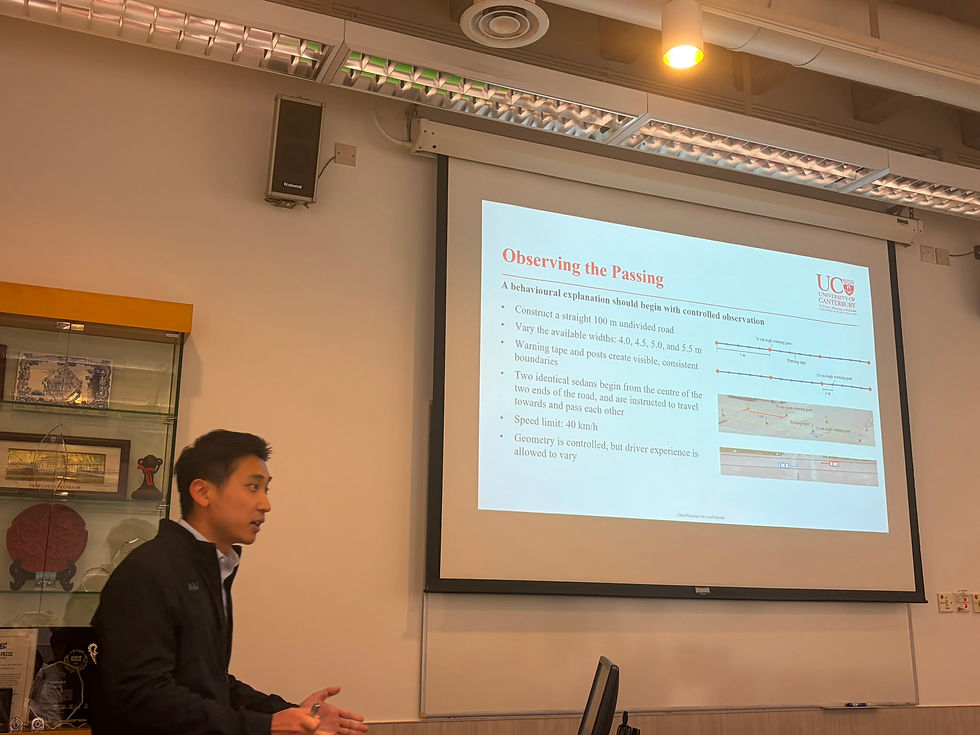
Traffic congestion is often studied through aggregate flow relationships or increasingly sophisticated data-driven models. Yet many traffic phenomena ultimately emerge from countless local interactions among individual drivers. Understanding how these microscopic interactions generate macroscopic traffic patterns remains a fundamental challenge in transportation science. This seminar presents a behavioral modelling framework for investigating vehicle interactions on bidirectional undivided narrow roads, where opposing traffic creates lateral friction and complex passing maneuvers. Drawing on the concept of behavioral heuristics, a heuristic-based passing model is developed in which drivers continuously respond to perceived visual stimuli and steering uncertainty when selecting both their driving direction and speed. Unlike conventional rule-based traffic models, the framework provides an interpretable behavioral explanation of how drivers navigate constrained environments. The model is calibrated and validated using controlled field experiments involving real vehicles and drivers on roads of different widths. The results show that the proposed approach accurately reproduces observed passing trajectories, speed adjustments, and clearance distances. More importantly, when embedded within a traffic simulation framework, the same microscopic behavioral principles successfully reproduce macroscopic speed–density relationships observed in real-world traffic streams. The findings demonstrate how simple behavioral heuristics can give rise to complex traffic dynamics and offer new insights into the behavioral foundations of congestion formation, roadway design, and next-generation traffic modelling.

About the speaker
Dr Wai Wong is a Senior Lecturer in the Department of Civil and Environmental Engineering at the University of Canterbury, New Zealand. He holds a PhD in Transportation and Traffic Engineering and a Bachelor of Engineering degree in Civil Engineering with First Class Honours, both from the Department of Civil Engineering at The University of Hong Kong. After completing his doctorate, he worked as a Postdoctoral Research Fellow in the Department of Civil and Environmental Engineering at the University of Michigan, USA. His research interests include traffic flow theory, transportation data analytics, connected and automated vehicles, intelligent transportation systems, traffic signal optimisation, and emergency transport and evacuation. His work has been published in leading international journals, including Transportation Science, Transportation Research Part B, and Transportation Research Part C, and presented at major international conferences, including the International Symposium on Transportation and Traffic Theory. His research has received support from several funding agencies, including New Zealand’s Ministry of Business, Innovation and Employment and the Royal Society of New Zealand.
- ALL ARE WELCOME -


Comments