top of page

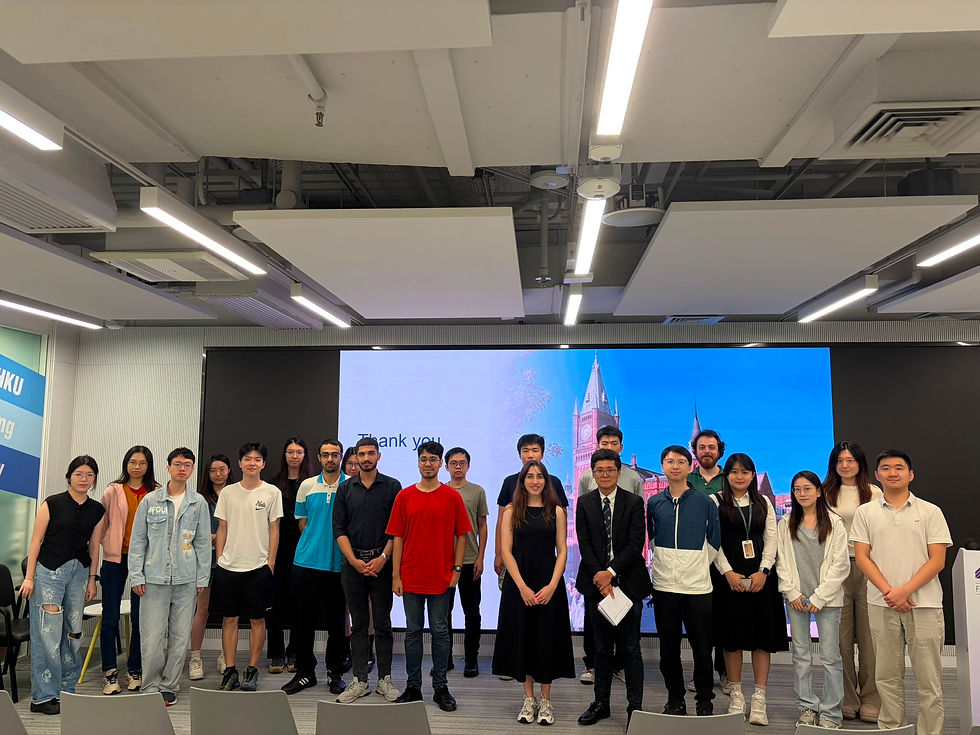
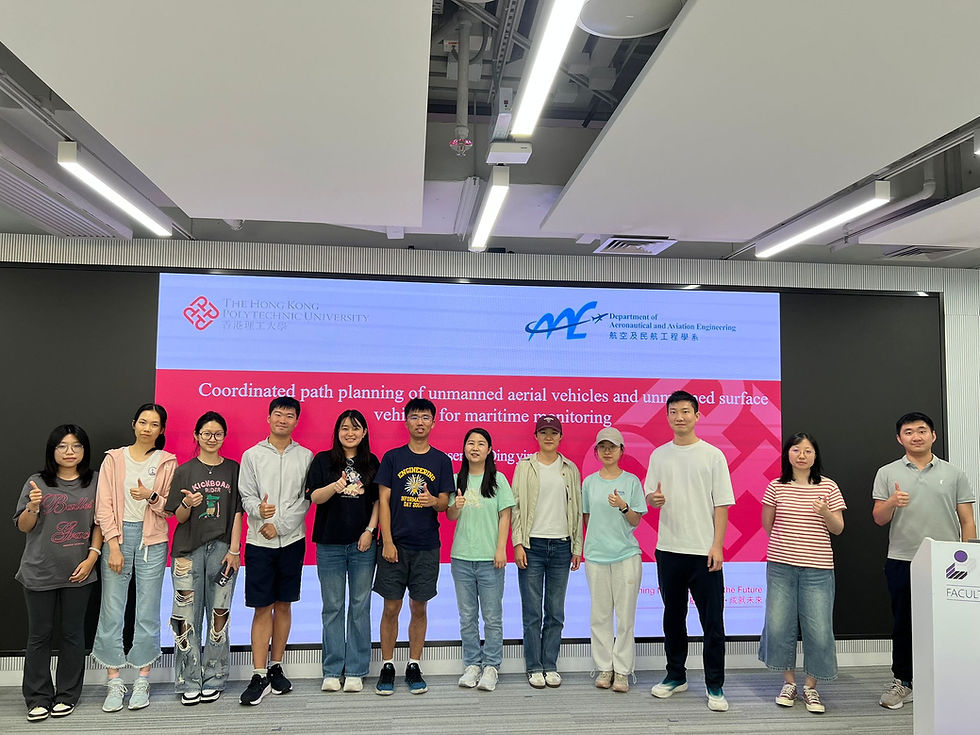
Title: Coordinated path planning of unmanned aerial vehicles (UAVs) and unmanned surface vehicles (USVs) for maritime monitoring

Speaker: Ms. Qingying He (The Hong Kong Polytechnic University)

Date: May 28, 2026 (Thursday)

Time: 3:00 pm - 4:00 pm

Venue: Tam Wing Fan Innovation Wing Two, HKU

ITS Student Committee will provide a beverage for registered participants.


Abstract: Maritime monitoring often involves dispersed tasks over open water, where fixed support infrastructure is limited and costly to deploy and maintain. UAVs provide fast aerial sensing, while USVs can operate for longer periods and support UAV launch, recovery, and energy replenishment. The key planning challenge is to coordinate UAV sorties and USV routes so that monitoring tasks and launch--recovery operations remain feasible. This talk presents optimization models and scalable algorithms for UAV--USV coordinated path planning. The study starts from a deterministic setting, where coordination and synchronization are captured through a mixed-integer linear programming model and solved by customized exact and heuristic algorithms. It then considers travel time uncertainty caused by weather, waves, and currents, and develops a robust optimization framework to improve synchronization reliability. It further addresses real-time planning with imperfect operational information, where a cluster-wise robust optimization method is used to update decisions while accounting for heterogeneous forecast errors. Numerical experiments in the context of Guangdong--Hong Kong--Macao Greater Bay Area show that the proposed methods are effective, computationally efficient, and reliable under uncertainty. The framework provides a practical decision-support tool for operating heterogeneous autonomous systems in uncertain maritime environments.


Bios: Qingying He is currently a PhD candidate at the Department of Aeronautical and Aviation Engineering, The Hong Kong Polytechnic University, under the supervision of Prof. Wei Liu. She holds a BSc in Mathematics and Applied Mathematics from Northeastern University and an MSc in Computational Mathematical Finance (with Distinction) from University of Edinburgh. Her research focuses on transportation network modeling, optimization, and data-driven decision-making, with an emphasis on multi-modal coordination across unmanned aerial, surface, and ground vehicles. Her research has been published in world-leading journals in the field, such as TR Part B, TR Part E, IEEE T-ITS and Transportmetrica B.


Title: More-than-Human Urban Accessibility: Veterinary Care and Pet-Friendly Public Transport

Speaker: Mr. Ka Yiu (Benjamin) NG (Department of Geography)

Date: May 22, 2026 (Friday)

Time: 11:00 am - 12:00 nn

Venue: Room 1010, CLL, Department of Geography, 10/F, The Jockey Club Tower, The University of Hong Kong

ITS Student Committee will provide a beverage for registered participants.


Abstract: Traditional urban accessibility research largely focuses on people’s access to resources, offering only a limited account of how more-than-human beings may restrict or enable human accessibility. Scholarship in New Animal Geography calls for closer attention to the agency and subjectivity of more-than-human beings, and to the ways their encounters with humans shape reciprocal relationships. Against a backdrop of rising pet ownership globally and recent debate in Hong Kong about pet-friendly public transport initiatives, this seminar introduces: (1) the current literature on spatial access to veterinary care worldwide; (2) spatial access to veterinary care in Hong Kong; and (3) a preliminary exploration of public perceptions of pet-friendly public transport in Hong Kong.


Bios: Mr. NG holds a Bachelor of Social Sciences (First Class Honours) in Geography & Urban Governance and an MPhil in Geography from HKU. He has gained academic and applied research experience in transport and health through training at HKU, working at UNICEF Hong Kong (Advocacy Officer, Policy & Research) and at the Science Unit at Lingnan University (System Officer) before joining the PhD programme in 2025. His research interests sit at the intersection of GIScience, transport, and health, with a current focus on: (1) applied 3D GIS and accessibility modeling; (2) the built environment and health; and (3) pet-friendly public transportation.


Title: Unequal Traffic-Related Air Pollution: Identifying Vehicular Drivers of Exposure Disparity

Speaker: Mr. Chenming Niu (Department of Geography)

Date: May 13, 2026 (Wednesday)

Time: 2:00 pm - 3:00 pm

Venue: Room 1010, CLL, Department of Geography, 10/F, The Jockey Club Tower, The University of Hong Kong

ITS Student Committee will provide a beverage for registered participants.


Abstract: Traffic-related air pollution is a major source of near-road environmental inequality in dense cities, yet the vehicular sources of exposure disparities are often obscured by broad vehicle groupings and daily average estimates. In this seminar, we present a data-driven framework for Hong Kong that integrates high-resolution traffic counts, street imagery, detector data, machine learning, and computer vision to estimate hourly vehicular NOx and PM2.5 emissions across all road segments. The results reveal substantial exposure disparities across income and ethnic groups, with the main vehicular contributors varying over the day. Delivery fleets play a larger role in daytime disparities, while franchised buses become more important in the evening. These findings show the value of vehicle-specific and time-resolved analysis for understanding environmental inequalities and informing more targeted transport and air quality policies.


Bios: Chenming's research interest lies in traffic emission modeling, shared mobility modeling, environmental justice analysis, and transport equity analysis. Prior to joining HKU, he earned a Bachelor of Engineering in Traffic and Transportation from Southeast University and a Master of Science in Transportation Engineering from the University of California, Berkeley. 


© 2026 by Institute of Transport Studies. The University of Hong Kong.
bottom of page